Home › Guides › How to Improve Reaction Time
How to Improve Your Reaction Time
Last updated:
On a simple visual signal, adults' average reaction time is usually 200 to 300 milliseconds (see our average reaction time guide). You can realistically take tens of milliseconds off that by sleeping properly, practising the exact task, cutting distractions, using caffeine sensibly and fixing your setup. You cannot halve it, and anyone promising that is selling something.
Start with a number. You can't tell whether anything is working without a baseline. Take the test, note your average over five attempts, and come back to it after a week of changes.
Can you train reaction time?
Yes, within limits. Two things change your result: how quickly your brain and body handle the signal, and how well you're currently performing relative to your own best. The second is where nearly all the easy gains live. In the studies below, more sleep was worth about 36 ms and caffeine about 11 to 18 ms, which is more than most people expect.
The first is much harder to shift. Training mostly makes you better at the exact task you practise. A large 2016 review of brain-training studies found strong evidence for gains on the trained tasks but little evidence that those gains carry over to different tasks or everyday life.1 So the practical goal isn't a new nervous system. It's turning up at your own ceiling more often.
1. Sleep: the biggest measured effect
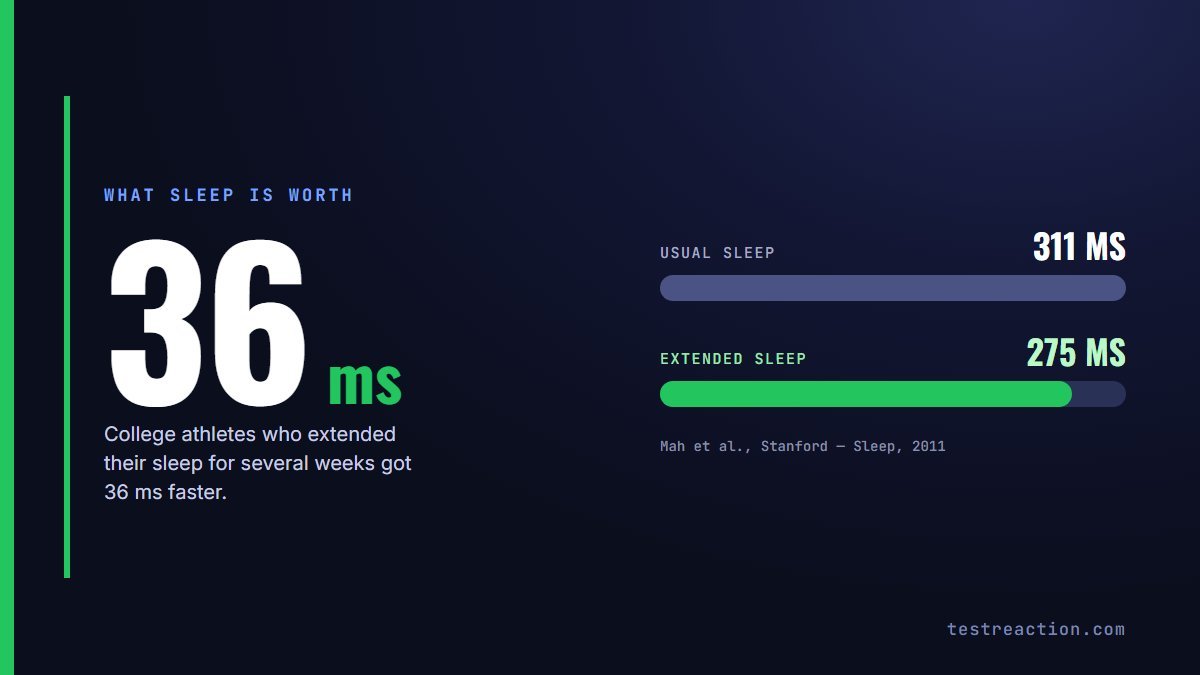
Of everything on this page, sleep had the biggest measured effect. When researchers at Stanford asked eleven college basketball players to extend their sleep to ten hours in bed for five to seven weeks, their average reaction time on a standard vigilance test improved from 311 ms to 275 ms.2 Their sprint times, free throws and three-point shooting improved too.
Tiredness also produces lapses: unusually slow responses that wreck an average. On the psychomotor vigilance task, a standard reaction test in sleep research, a lapse is any response slower than 500 milliseconds (or no response at all),3 and lapses become more frequent as sleep loss builds up. If your test results are inconsistent rather than uniformly slow, sleep is the first thing to look at.
2. Practise the exact task
Reaction training is stubbornly specific. Practising a click test makes you better at click tests; practising returns of serve makes you better at returns of serve. Pick the version that matches your goal, then repeat it with unpredictable timing so you can't anticipate.
Our reaction time trainer guide has the drills, exercises and a four-week plan. If you play games, the gaming guide covers aim trainers, monitors and input lag.
3. Focus and expectation
Attention is a measurable part of your result. Watching the signal area rather than glancing around, muting notifications, and committing to respond rather than deliberating all shorten the gap. So does knowing roughly when the signal is coming, which is exactly why this test uses a random 0.8 to 3 second delay: it stops you from scoring your guesswork instead of your reaction.
What doesn't help is tension. Gripping the mouse and staring hard tends to produce early clicks, which don't count, and a worse average when you overcorrect.
4. Caffeine, used deliberately
Caffeine has one of the better-evidenced effects. In a 2024 dose-response study of 24 first-person-shooter players, reaction time on a vigilance test improved from 291 ms on water to 280 ms after 1 mg of caffeine per kg of body weight (about 83 mg for the average player) and 273 ms after 3 mg per kg (about 250 mg), with the effect strongest 60 to 75 minutes after taking it.4 Scores on the aim-trainer shooting tasks improved as well, though click accuracy itself didn't change.
Two cautions. The gain is about 11 to 18 ms, not a transformation. And caffeine late in the day costs you sleep, which is worth more than the caffeine gives back.
5. Your setup
Part of every result you see is your equipment, not you. A 60 Hz screen adds up to about 17 ms of waiting for the next frame; a 144 Hz screen cuts that to about 7 ms. Wireless peripherals, background apps and browser load all add their own delay.
- Use a wired mouse or keyboard if you have one.
- Close other tabs and apps before testing.
- Test on the same device every time, or your history is meaningless.
This is also why comparing your phone result to a friend's gaming PC result proves nothing. Our average reaction time guide shows the spread of real results from this site so you can see where you actually sit.
Reflexes and reaction time are not the same thing
People searching for how to improve their reflexes usually mean reaction time, but the distinction matters. A true reflex, like your knee jerking when a doctor taps the tendon, is handled by the spinal cord without a conscious decision, and everyday practice won't make it faster in any useful way. What you can train is the voluntary chain: see the signal, decide, move. When a goalkeeper is described as having fast reflexes, what they really have is a practised, well-read reaction.
How much can you actually improve?
A reasonable expectation: someone averaging 260 ms who fixes their sleep, practises a few times a week and tests on decent hardware might take 20 to 40 ms off, landing somewhere around 220 to 240 ms. Averages in the low 100s almost always mean anticipation (clicking early) or a timing problem rather than a real visual reaction.
Age plays a part too. In a study of more than 7,000 UK adults published in Psychology and Aging, simple reaction time changed little until around 50, while tasks requiring a choice slowed throughout adulthood.5
What doesn't work
- Supplements promising faster reflexes. Apart from caffeine, we couldn't find a supplement with solid evidence for faster reaction time.
- Testing repeatedly in one sitting to chase a personal best. That measures luck and fatigue, not improvement.
- Generic brain-training apps. Gains tend to stay inside the app.1
- Comparing across devices. Different hardware, different result, no useful conclusion.
Questions people ask
How long does it take to improve?
Focus changes help straight away. Catching up on sleep can take a few weeks to show fully: in the Stanford study, players extended their sleep for 5 to 7 weeks. Practice gains tend to come early and then level off.
Is 200 ms good?
It's better than average on this site's results. See the full distribution to place yourself properly.
Do video games improve reaction time?
The research is mixed, and we cover it in detail in the gaming guide.
Can older adults improve?
Yes. The same levers (sleep, practice, focus, a good setup) help at any age.
Sources
- Simons, D.J. et al. (2016). Do "brain-training" programs work? Psychological Science in the Public Interest.
- Mah, C.D., Mah, K.E., Kezirian, E.J., & Dement, W.C. (2011). The effects of sleep extension on the athletic performance of collegiate basketball players. Sleep.
- Lee, I.S. et al. (2010). Number of lapses during the psychomotor vigilance task as an objective measure of fatigue. Journal of Clinical Sleep Medicine.
- Rogers, E.J. et al. (2024). Caffeine improves the shooting performance and reaction time of first-person shooter esports players: a dose-response study. Frontiers in Sports and Active Living.
- Der, G., & Deary, I.J. (2006). Age and sex differences in reaction time in adulthood: results from the United Kingdom Health and Lifestyle Survey. Psychology and Aging.
This test and these guides are for general information and entertainment only and are not medical advice. See our Disclaimer.