Home › Guides › Average Reaction Time
Average Reaction Time: See Where You Rank
Last updated:
Adults' average reaction time to a simple visual signal is usually around 200 to 300 milliseconds. Below, you can see how people who took the reaction time test on this site actually scored, and where your own result falls.
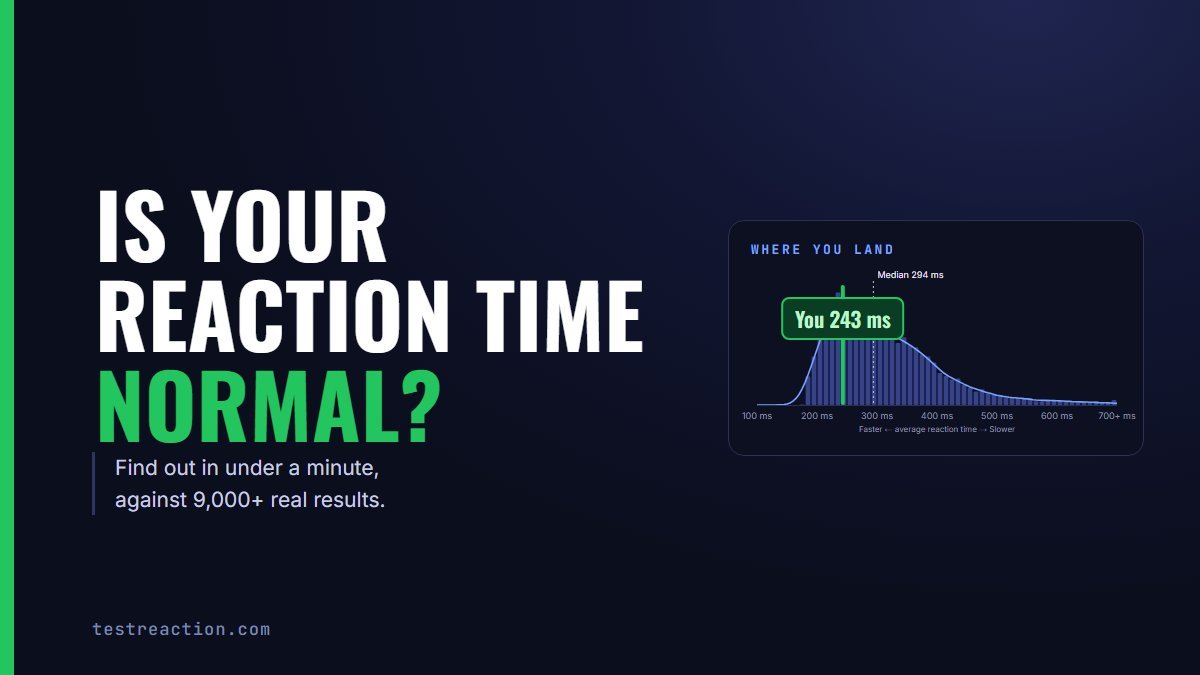
Take the test, add your result, and come back here to see where you rank.
Take the Reaction Time TestReaction time results from this site
Based on 11,963 results added by people who took the test on this site, the average reaction time is 310 ms and the median is 289 ms. Half of all results fall between 243 and 356 ms. The fastest 10% are under 216 ms, and the slowest 10% are over 430 ms.
What is a normal human reaction time?
Reaction time is the delay between seeing a signal and responding to it. For a simple task like clicking when a screen turns green, adults' average reaction time in lab studies is usually somewhere between 200 and 300 milliseconds, and it gets slightly slower with age.1 This site rates each attempt on the following scale:
- 199 ms or less: excellent
- 200–249 ms: very good
- 250–299 ms: above average
- 300–349 ms: average
- 350–449 ms: below average
- Over 449 ms: slow
Is my reaction time good?
It depends on who you compare yourself with, so here is the answer from the 11,725 real results added on this site. An average under 289 ms is faster than half of them. Under 250 ms beats about 71% of results, and under 200 ms puts you in the fastest 4%. Slower than 356 ms is in the slowest quarter, and the section on slow results below covers the usual reasons.
| Your average | Rating on this test | Faster than |
|---|---|---|
| 199 ms or less | excellent | 96% or more of results here |
| 200–249 ms | very good | 71–96% of results here |
| 250–299 ms | above average | 45–71% of results here |
| 300–349 ms | average | 27–45% of results here |
| 350–449 ms | below average | 8–27% of results here |
| Over 449 ms | slow | fewer than 8% of results here |
What is the fastest human reaction time?
You will find very precise "world record" reaction times quoted online, often with a name attached. Treat them with caution. We couldn't find any independently verified world record for simple human reaction time, because the result depends so much on how it is measured: the signal, the equipment, and what counts as a reaction.
Here is what is actually documented:
- Sprinting draws the line at 100 ms. At major athletics events, the starting system flags any reaction less than 0.100 seconds after the gun as a possible false start, and the starter then checks it.2 Sprinters react to a sound, and people respond to sound faster than to light,3 so a genuine reaction to something you see is even less likely to beat 100 ms.
- Guinness records narrower tasks. Guinness World Records lists the fastest response time with a punch at 0.186 seconds, set in Finland in 2020.4 Its 50 ms record for the fastest artificially-assisted reaction isn't a human reaction at all: electrical muscle stimulators moved the muscles.5
- On this site, the fastest 10% of averages are under 216 ms, and averages under 100 ms are rejected as unrealistic.
So a single click under 100 ms was almost certainly a lucky guess, not a reaction. An average over several attempts is the number that means something.
How fast are human reflexes?
Faster than any reaction you can measure with a test, because a true reflex skips the decision. In nerve tests, a spinal reflex called the H-reflex shows up about 40 to 45 milliseconds after the nerve is stimulated.6 A reaction time test measures something slower: seeing a signal, recognising it, and choosing to move. That is why even very quick people score well above 100 ms. Our guide to improving reaction time explains the difference and what you can actually train.
What affects reaction time, and why yours might be slow
- Your device. Your screen's refresh rate and the delay from your mouse, keyboard, or touchscreen all add time you can't see. If your result looks slow, rule this out first, and only compare results from the same device.
- Tiredness. Being tired causes lapses as well as generally slower reactions. On the psychomotor vigilance task, a standard reaction test in sleep research, any response slower than 500 ms counts as a lapse, and lapses become more frequent as sleep loss builds up.7 One lapse can make a whole average much slower.
- Age. In a study of more than 7,000 UK adults, simple reaction time changed little until around age 50, while choice reaction time slowed throughout adulthood.8
- Distraction and practice. Looking away, or being new to the test, adds milliseconds. A warm-up series usually helps.
- Guessing. Trying to predict when the screen will change leads to early clicks, which don't count. The random delay in the test is there to prevent guessing.
If your reactions have become noticeably slower for no obvious reason, mention it to a doctor. This test is for comparison and fun, and can't diagnose anything. For what genuinely helps, see how to improve your reaction time.
How to get your most accurate result
- Use the same device and browser each time so your results are comparable.
- A wired mouse or keyboard can add less delay than some wireless devices or touchscreens.
- Close other tabs and apps that might slow down your computer.
- Stay focused on the test area and complete a few series. An average over several attempts means more than a single fast click.
How these results are collected
- Each result is the average of 5 valid attempts by someone who chose Add my result after finishing the test.
- Only that one number is saved. No name, email address, IP address, device details, or cookies are stored with it.
- Averages outside 100–1,000 ms are rejected as unrealistic. Once there are 100 or more results, the fastest and slowest 1% are left out of the chart.
- Anyone can add a result, and people use different devices, so this is a fun comparison rather than a scientific study.
For more about what is and isn't collected, see our Privacy Statement.
More reaction time guides
- How to improve your reaction time — sleep, practice, focus and caffeine, and what each one is actually worth.
- Reaction time trainer — exercises, drills, games and a four-week plan.
- Reaction time for gaming — what professionals score, and the setup that costs you milliseconds.
Sources
- Woods, D.L., Wyma, J.M., Yund, E.W., Herron, T.J., & Reed, B. (2015). Factors influencing the latency of simple reaction time. Frontiers in Human Neuroscience.
- World Athletics. Book of Rules, Book C – C1.1 & C2.1 Competition Rules and Technical Rules, Technical Rule 16.6 (the start).
- Jain, A., Bansal, R., Kumar, A., & Singh, K.D. (2015). A comparative study of visual and auditory reaction times on the basis of gender and physical activity levels of medical first year students. International Journal of Applied and Basic Medical Research.
- Guinness World Records. Fastest response time (punch).
- Guinness World Records. Fastest artificially-assisted reaction times.
- Ramani, P.K., Lui, F., & Arya, K. (2025). Nerve Conduction Studies and Electromyography. StatPearls, NCBI Bookshelf.
- Lee, I.S. et al. (2010). Number of lapses during the psychomotor vigilance task as an objective measure of fatigue. Journal of Clinical Sleep Medicine.
- Der, G., & Deary, I.J. (2006). Age and sex differences in reaction time in adulthood: results from the United Kingdom Health and Lifestyle Survey. Psychology and Aging.
This test is for general information and entertainment only and is not a medical test. See our Disclaimer.