Home › Guides › Reaction Time for Gaming
How to Improve Reaction Time for Gaming
Last updated:
In a duel, many of the milliseconds you can win back are in your monitor, your settings, your warm-up and your crosshair placement. Here's what professional players really score, whether video games improve reaction time, and the changes that cut measurable time off the gap between an enemy appearing and your shot landing.
Get your baseline first. Five attempts, one number. Then use the same device every time you retest, because a different monitor or mouse can shift your result, so you won't be comparing like with like.
What pro gamer reaction time actually looks like
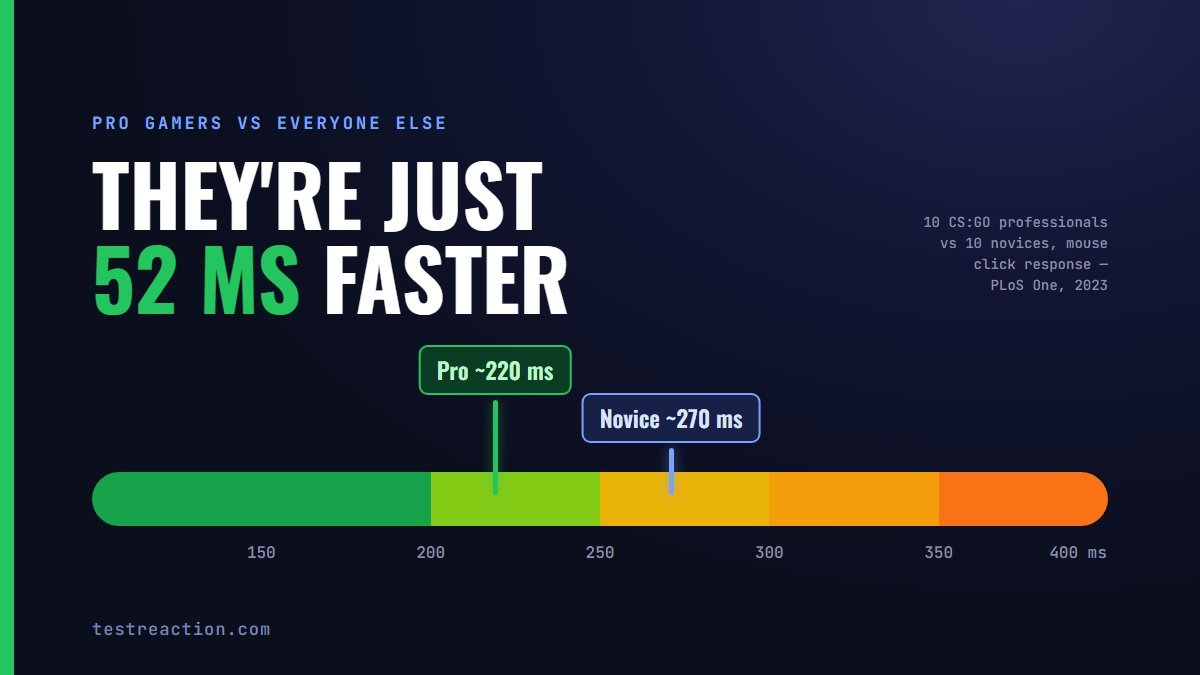
Professionals are faster, but not by the margin the internet suggests. In a 2023 study in PLoS One, researchers compared ten professional CS:GO players with ten novices. The pros were about 52 ms faster on a mouse click response, 25 ms faster on a keyboard response and 64 ms faster on a choice task. Their brain responses also arrived 20 to 70 ms earlier.1
Note what that means in practice. The gap is real and decisive in a fight, but it's about 220 ms against about 270 ms on a mouse click, not 200 ms against 50 ms. It's also a small study, so treat the exact numbers as indicative rather than definitive.
The pros' brain responses also came earlier, even on a simple colour task unrelated to the game. The study can't tell whether that comes from years of play or from people who are naturally quick choosing to go pro.
Do video games improve reaction time?
This is the most argued-over question in the field, and the honest answer is "somewhat, with caveats".
In favour: a well-known Current Biology study found action game players made decisions substantially faster than non-players without losing accuracy, and that non-players trained for 50 hours on action games improved measurably compared with a control group playing a slow-paced game.2
Against: other researchers argue the field's claims have outpaced the evidence, pointing at study designs that weren't standardised or well controlled, such as missing active control groups.3 And in a study of 66 amateur esports players, the 32 who played 15 minutes of VR (Beat Saber) a day for eight days improved their eye–hand coordination by about 17%, but their reaction time showed no significant change.4
The practical reading: playing fast games makes you better at fast games. Don't expect it to rebuild your general reaction speed, and don't expect a reaction test score to predict your rank.
Win the milliseconds you don't control
Before training anything, remove the delay sitting between your game and your eyes. None of this changes your biology; all of it changes how soon you can act.
| Change | Roughly what it's worth |
|---|---|
| 60 Hz → 144 Hz monitor | Up to about 10 ms less waiting for the next frame |
| 144 Hz → 240 Hz monitor | Another 3 ms or so, with diminishing returns |
| Turning off V-Sync | Removes a queue that can add a frame or more of delay |
| Higher frame rate (lower settings) | Less time between the game state and what you see |
| Wired mouse, 1000 Hz polling | A small, consistent gain over some wireless setups |
| Closing background apps | Fewer stutters, which can easily cost more than a refresh-rate upgrade saves |
Ping is worth separating out here. A high ping doesn't slow your reaction time, it delays when the server tells you the enemy exists. Both feel identical in the moment, and only one of them is you.
Train the part that's actually slow
In a real duel, finding the target and moving your crosshair take time on top of your reaction. So train those too.
- Aim trainers. Ten minutes of flicking and tracking drills before you play. Measure a score so you know whether you're warming up or declining.
- Crosshair placement. Keeping your aim at head height and pre-aimed at common angles removes the movement entirely. It's the cheapest millisecond in gaming.
- Map knowledge. Knowing where enemies appear converts a reaction into an expectation.
- Deathmatch warm-up. Ten to fifteen minutes before ranked play, not two hours.
- Reaction drills away from the game. Our reaction time trainer guide has exercises, drills and a four-week plan.
Caffeine, sleep and tilt
Caffeine is one of the few boosts that has been tested on esports players. In a 2024 dose-response study of 24 first-person-shooter players, reaction time improved from 291 ms on water to 280 ms at about 83 mg of caffeine and 273 ms at about 250 mg, peaking 60 to 75 minutes after taking it.5 Scores on the aim-trainer shooting tasks improved too, though click accuracy itself didn't change. That's about 11 to 18 ms, which matters in a duel but won't fix a bad setup.
Sleep may matter even more, and it's the one most players sacrifice. Sleep-extended athletes in a Stanford study improved their average reaction time from 311 ms to 275 ms.6 Late-night ranked sessions are the most reliable way to play below your own level. The general improvement guide covers this in detail.
A 15-minute warm-up before you queue
- Five minutes on an aim trainer: half tracking, half flicking.
- Five to ten minutes of deathmatch, focusing on crosshair placement rather than kills.
- One series on this reaction test to see whether you're sharp or sluggish today. If your average is well above your normal, you may be tired, and ranked play will likely show it.
Questions people ask
What's a good reaction time for gaming?
On the reaction time test on this site, under 250 ms counts as fast and under 200 ms is excellent. In one study, ten professional CS:GO players averaged about 220 ms on a mouse-click test.1 Compare yourself against real results in our average reaction time guide.
Can I reach pro reaction times?
Sleep, a good setup and practice can narrow the gap. The rest of their advantage is recognition and decision-making built over years.
Does a higher refresh rate help?
Yes, but with sharply diminishing returns above 144 Hz, and only after you've fixed frame drops.
Do reaction times decline with age for gamers?
In a study of more than 7,000 UK adults, simple reaction time changed little until around 50, while reaction time on choice tasks slowed throughout adulthood.7 That's one reason experienced players lean on positioning and game sense.
Sources
- Gostilovich, S. et al. (2023). Biomarkers of professional cybersportsmen: event related potentials and cognitive tests study. PLoS One.
- Green, C.S., Pouget, A., & Bavelier, D. (2010). Improved probabilistic inference as a general learning mechanism with action video games. Current Biology.
- Bisoglio, J. et al. (2014). Cognitive enhancement through action video game training: great expectations require greater evidence. Frontiers in Psychology.
- Lachowicz, M. et al. (2024). Amplifying cognitive functions in amateur esports athletes: the impact of short-term virtual reality training on reaction time, motor time, and eye–hand coordination. Brain Sciences.
- Rogers, E.J. et al. (2024). Caffeine improves the shooting performance and reaction time of first-person shooter esports players: a dose-response study. Frontiers in Sports and Active Living.
- Mah, C.D. et al. (2011). The effects of sleep extension on the athletic performance of collegiate basketball players. Sleep.
- Der, G., & Deary, I.J. (2006). Age and sex differences in reaction time in adulthood: results from the United Kingdom Health and Lifestyle Survey. Psychology and Aging.
This test and these guides are for general information and entertainment only and are not medical advice. See our Disclaimer.