Home › Guides › Reaction Time Trainer
Reaction Time Trainer: Exercises, Drills and Games
Last updated:
The quickest way to train reaction time is to practise the exact thing you want to get faster at, then measure it the same way every time. Below are the exercises and drills worth doing, the games that genuinely train reaction speed, a four-week plan, and an honest look at how much any of this moves the number.
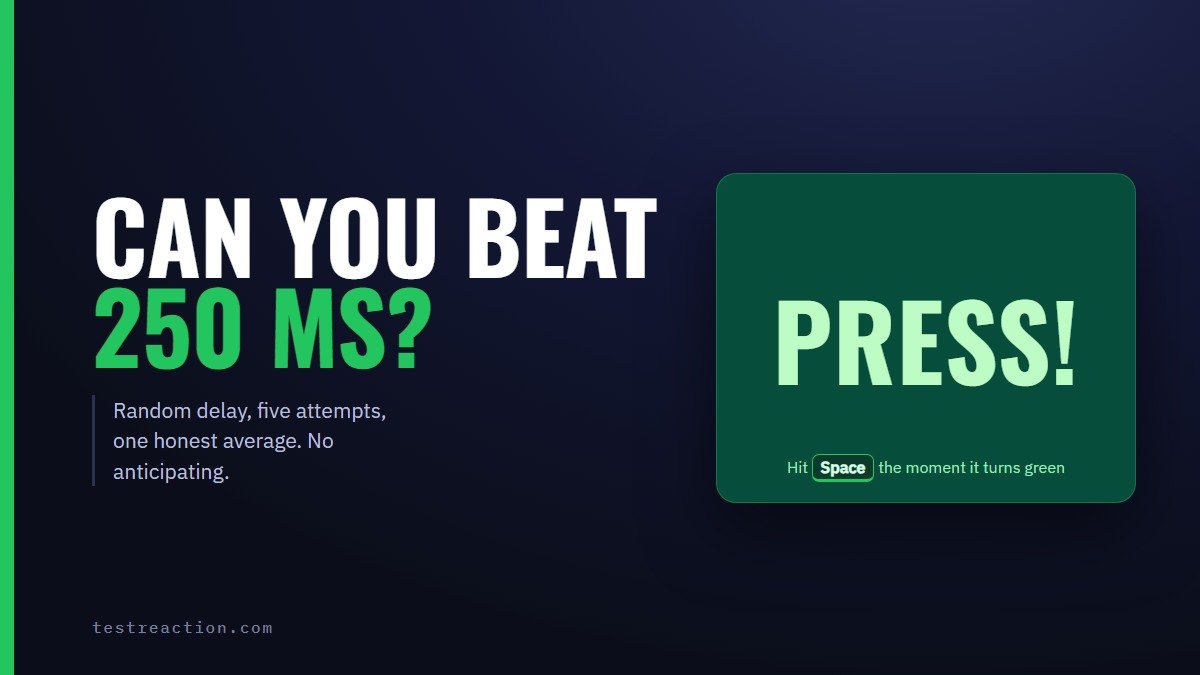
Train here first. The test on this site is a reaction time trainer in its own right: a random delay of 0.8 to 3 seconds, five attempts per series, and an average at the end. Clicking early doesn't count, so you can't cheat by anticipating.
How to use the test as a trainer
- Warm up with one series of five attempts and ignore the result. Your first series is nearly always your slowest.
- Do two or three more series and note the average of each.
- Keep your setup identical: same device, same browser, same chair, same time of day. A different mouse or screen can shift your result more than a month of training.
- Compare weekly, not daily. A change of 10 to 20 ms between series is normal variation, not progress.
Once you have a number, see how it compares in our average reaction time guide, which charts real results from visitors to this site.
What reaction training can and can't change
Be realistic about the size of the prize. Most adults land between 200 and 300 milliseconds on a simple visual task, and training moves that by tens of milliseconds, not hundreds.
Two findings are worth knowing. On the encouraging side, people who trained on fast action video games for 50 hours made decisions faster than a control group without losing accuracy, in work by Green, Pouget and Bavelier published in Current Biology.1
On the sobering side, a 2024 study in Brain Sciences put 66 amateur esports players through eight days of virtual reality training. Their eye–hand coordination improved by about 17%, but their measured reaction time didn't change at all.2
The lesson: practice reliably improves the specific skill you practise. General reaction speed is much harder to shift, and reviewers have argued that claims about brain training have run ahead of the evidence.3 Train the thing you care about being fast at.
Reaction time exercises you can do anywhere
These reaction time exercises need almost no equipment. Each one gives you an unpredictable cue, which is the part that matters.
1. The ruler drop
A partner holds a 30 cm ruler above your open hand and drops it without warning. Catch it and read the number where your fingers close. Lower is faster, and it gives you a physical measure to beat. It's the classic reaction time exercise for a reason: no screen, no setup, instant feedback.
2. Wall ball catches
Throw a tennis ball against a wall and catch it, standing closer as you improve. Closing the distance is what forces faster responses. Alternate hands, then try it with a partner throwing so you can't predict the timing.
3. Reaction ball bounces
A reaction ball has an uneven, six-sided shape that bounces unpredictably. Drop it, let it bounce once, and catch it. This trains the sequence that matters in sport: see the change, decide, move.
4. Partner cue drills
Face a partner who points left, right, up or down at random, and move accordingly. Adding a choice ("point left, you step right") makes it a choice reaction drill, which is closer to what most sports and games demand.
5. Light and sound cues
Set a phone to beep at random intervals and respond with a set movement. Light-based trainers, such as the pods used by coaches, do the same job with a visual cue and automatic timing.
6. Starts from a cue
Sprint starts, shuttle starts, or simply standing up and moving on a clap. These reaction time workouts train the whole chain from signal to full-body movement, not just a finger press.
Reaction speed training for sports
Most activities that require reaction time are not simple, one-signal tasks. They ask you to read a situation, choose between options, and move. Match the drill to the demand:
| Sport | Drills that fit |
|---|---|
| Racket sports | Wall rallies at close range, partner-fed random shots, shortened court games |
| Goalkeeping | Close-range reaction saves, deflected shots, sight-blocked serves |
| Combat sports | Focus mitt call-outs, slip lines on a random cue, partner touch-sparring |
| Sprinting | Starts on a gun, clap or light, from varied positions |
| Team field sports | Small-sided games, coloured-cone calls during movement, reaction ball work |
Games that train reaction speed
Not every game marketed as a reaction time training game earns the label. The useful ones share two traits: an unpredictable cue, and feedback you can measure.
- This reaction test. The simplest honest measure: one signal, one response, a number at the end.
- Aim trainers. Built for shooters, they combine target acquisition with speed, which is closer to a real gaming demand than a bare click test.
- Rhythm and VR games. Titles like Beat Saber sharpen eye–hand coordination noticeably, even though the study above found no change in pure reaction time.
- Fast action games. The research on transfer is genuinely mixed, but they are at least practice at responding to unpredictable events under pressure.
If gaming is your goal, our guide to improving reaction time for gaming covers monitors, input lag and what professional players actually score.
A four-week reaction training plan
Short and frequent beats long and occasional. Fifteen minutes, three times a week, is plenty.
| Week | Sessions | Focus |
|---|---|---|
| 1 | 3 × 15 min | Baseline test, then simple cues: ruler drop, wall ball, this test |
| 2 | 3 × 15 min | Add choice: partner cue drills, reaction ball, sound cues |
| 3 | 3 × 15 min | Add movement: starts, shuttles, sport-specific drills |
| 4 | 3 × 15 min | Mix all three, then retest under the same conditions as week 1 |
Train when you're fresh. Reaction time is one of the first things to suffer when you're tired, so a session at the end of a long day mostly measures your fatigue. Our guide on how to improve reaction time goes into sleep, caffeine and focus, which move the number more than any drill.
How to measure progress without fooling yourself
- Always use the same device. Screen refresh rate and mouse or touchscreen delay are built into your result.
- Use averages, not your best attempt. A single fast click is luck; an average over five is a measurement.
- Expect noise. Day-to-day swings of 10 to 20 ms mean nothing on their own.
- Log it. One number a week, in the same conditions, tells you more than twenty numbers in one evening.
Questions people ask
Can you train your reaction time?
Partly. Practice makes you faster at a specific task, and being rested and focused makes a measurable difference. What training won't do is turn an average 250 ms into 120 ms.
How long until I see an improvement?
The first few sessions bring the biggest change, mostly because you're learning the task. After that, progress is slow and small.
Do reaction balls and light trainers work?
For the skill they train, yes. Transfer to unrelated tasks is limited, so choose drills that resemble what you want to be fast at.
How many attempts should I do?
Three series of five. Longer sessions usually make your numbers worse as concentration fades.
Sources
- Green, C.S., Pouget, A., & Bavelier, D. (2010). Improved probabilistic inference as a general learning mechanism with action video games. Current Biology.
- Lachowicz, M. et al. (2024). Amplifying cognitive functions in amateur esports athletes: short-term virtual reality training. Brain Sciences.
- Bisoglio, J. et al. (2014). Cognitive enhancement through action video game training: great expectations require greater evidence. Frontiers in Psychology.
This test and these guides are for general information and entertainment only and are not medical advice. See our Disclaimer.